CopuAdapt:
An Attentional Copula Adapter For Improved Joint-Distribution Sampling In Probabilistic Time-Series Forecasting

Author

Benjamin R Redhead1,2, Chang Xu2, Cameron Barker1, Thomas L Lee1, Elliot J. Crowley3, Henry Gouk1, Víctor Elvira4, Amos Storkey1, Li Zhao2

Affiliations

1 School of Informatics, University of Edinburgh

2 Microsoft Research Asia

3 School of Engineering, University of Edinburgh

4 School of Mathematics, University of Edinburgh

Posted

October 10, 2026

Venue / status

Under review

Overview

Many time-series foundation models forecast variables independently, making it difficult to sample realistic combinations of future outcomes. CopuAdapt learns the dependencies between variables while keeping the forecasting model frozen.

The adapter uses recent observations to infer a sparse dependency graph, which guides an attentional copula model in generating joint samples. A final rank-matching step rearranges the backbone’s forecast values, preserving the empirical distribution for every variable and forecast step exactly.

Across four foundation-model backbones and eight benchmark datasets, CopuAdapt improves aggregate Variogram Score and RBF-MMD, which assess joint forecasts, while leaving the univariate CRPS unchanged.

Architecture
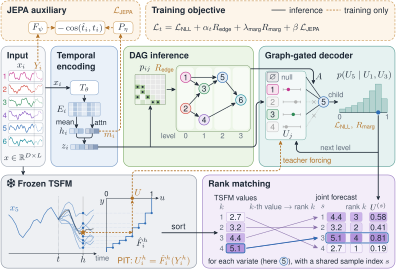
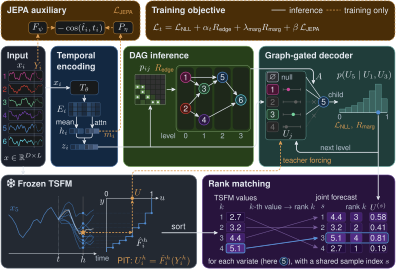
CopuAdapt architecture: observed time series feed a temporal encoder and sparse dependency-graph inference. The graph controls an attentional copula decoder; rank matching combines its samples with forecasts from a frozen time-series foundation model. An auxiliary prediction objective supports representation learning during training. CopuAdapt architecture: observed time series feed a temporal encoder and sparse dependency-graph inference. The graph controls an attentional copula decoder; rank matching combines its samples with forecasts from a frozen time-series foundation model. An auxiliary prediction objective supports representation learning during training.
CopuAdapt learns dependencies through a graph-gated decoder, then rank-matches its samples to the frozen backbone’s forecasts to preserve their empirical marginals. Dashed connections are used only during training.